

TIP-ChIP(TM) Assay Kit
- Images (1)
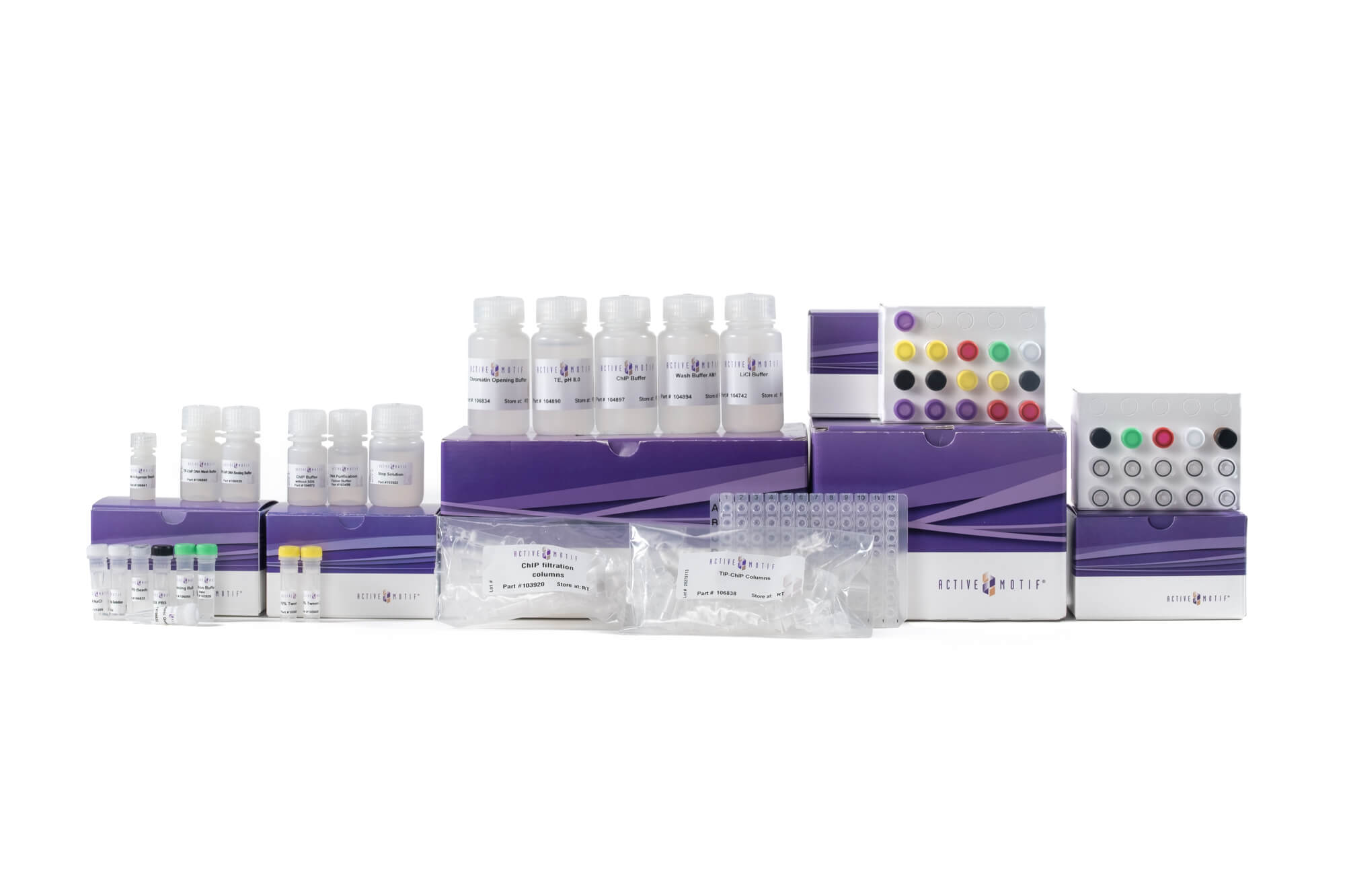
| Article Name: | TIP-ChIP(TM) Assay Kit |
| Biozol Catalog Number: | ACM-53211 |
| Supplier Catalog Number: | 53211 |
| Alternative Catalog Number: | ACM-53211 |
| Manufacturer: | Active Motif |
| Category: | Kits/Assays |
| High-throughput ChIP alternative |
TIP-ChIP is a high-throughput ChIP alternative with these key features:
TIP-ChIP (Tagmented, Indexed, and Pooled ChIP-Seq is a streamlined cost-effective method for performing ChIP-Seq on up to 96 samples in a single reaction, with lower input and reduced variability than traditional Chromatin Immunoprecipitation. TIP-ChIP is a high-resolution, two-step chromatin immunoprecipitation (ChIP) epigenetic technique designed to precisely map protein–DNA interactions genome-wide from individual samples that are indexed and pooled to enable high-throughput ChIP from 300,000 to 1 million cells per sample. This method is especially useful to perform ChIP in multiple samples in the same experiment. Because samples in TIP-ChIP are pooled together per target, there are fewer steps – only one IP per target as opposed to IPs per sample in traditional ChIP. ChIP-Seq is a well-established technique for mapping protein-DNA interactions and histone modifications genome-wide; however, there are some limitations to ChIP-Seq including the large sample input requirement of 1 to 10 Million cells, time-consuming and cumbersome protocol, difficult sample chromatin preparation, one sample processed per reaction, and batch effects. TIP-ChIP overcomes many of these limitations by combining samples into one reaction per immunoprecipitation (IP). By pooling samples, 300,000 to 1 million cells are needed per sample, and only 8 samples are needed to pool for one IP. Additionally, TIP-ChIP does not rely on traditional chromatin preparation, and instead utilizes Tn5 transposase to incorporate unique barcodes per sample. This streamlines the assay workflow, improves data quality, and eliminates batch effects.
How does TIP-ChIP work?
Figure 1. TIP-ChIP Assay Workflow. TIP-ChIP enables treamlined high-throughput ChIP-Seq with an unbiased tagmentation method followed by IP pull-down. What antibodies work in TIP-ChIP?Active Motif specializes in manufacturing high-quality antibodies to histones, histone modifications, chromatin proteins, and other factors, including a growing list of antibodies that we have experimentally validated in-house to work well in TIP-ChIP assays. TIP-ChIP works well with many antibodies that work in ChIP-Seq, but not all antibodies that have been validated for ChIP will work well in TIP-ChIP, and it is important to choose validated antibodies for the application. Guidelines for optimizing antibodies in TIP-ChIP are included in the manual.
TIP-ChIP Assay AdvantagesBy utilizing Tn5 transposase, indexing and tagmentation are done simultaneously. Tn5 in traditional ATAC-Seq methods is biased toward open chromatin regions, and in TIP-ChIP a modification to these steps results in unbiased tagmentation.
Figure 2. TIP-ChIP workflow starts with unbiased tagmentation. Tn5 tagmentation in TIP-ChIP is not biased to preferentially tagment only open chromatin regions.
TIP-ChIP Assay Kit Experimental DesignThe TIP-ChIP Assay Kit includes H3K27ac, H3K4me3, and RNA pol II phospho Ser2 antibodies to profile histone marks and transcription activation. These three antibodies together give a powerful view of active gene regulation and transcriptional dynamics. Depending on experimental questions and sample amounts, the breakaway 96-well plate can be set up to use 24 wells of each antibody, or in other combinations to optimize antibodies for other targets of interest as illustrated below.
(Click image to enlarge)
TIP-ChIP™ Assay Kit Contents
TIP-ChIP™ Assay Kit Data
Figure 3. TIP-ChIP Data Demonstrates Strong Concordance with ENCODE ChIP-Seq Data. H3K27ac was profiled in 12 barcoded K562 samples pooled into a single TIP-ChIP reaction and demultiplexed by barcode. Genomic browser tracks show pseudobulk signal from the pooled data (red), per-sample demultiplexed signal (purple) and ENCODE ChIP-Seq tracks (gold). Concordant peak positions and amplitudes indicate that TIP-ChIP multiplexing and deconfolution preserve locus-level resolution and data quality relative to confentional ChIP-Seq. |


|
|
ACM-53211 |
