

Pan-Akt Rabbit pAb, Unconjugated, Polyclonal
Catalog Number:
ABB-A18120
- Images (7)
| Article Name: | Pan-Akt Rabbit pAb, Unconjugated, Polyclonal |
| Biozol Catalog Number: | ABB-A18120 |
| Supplier Catalog Number: | A18120 |
| Alternative Catalog Number: | ABB-A18120-20UL,ABB-A18120-100UL,ABB-A18120-500UL,ABB-A18120-1000UL |
| Manufacturer: | ABclonal |
| Host: | Rabbit |
| Category: | Antikörper |
| Application: | ELISA, IF, IHC-P, IP, WB |
| Species Reactivity: | Human |
| Immunogen: | Recombinant protein (or fragment).This information is considered to be commercially sensitive. |
| Conjugation: | Unconjugated |
| Alternative Names: | AKT1/AKT2/AKT3, Pan-Akt |
| Human AKT serine-threonine protein kinase family includes three members AKT1,AKT2, AKT3, which are also often referred to as protein kinase B alpha, beta, and gamma. These highly similar AKT proteins all have an N-terminal pleckstrin homology domain, a serine/threonine-specific kinase domain and a C-terminal regulatory domain. These proteins are phosphorylated by phosphoinositide 3-kinase (PI3K). AKT/PI3K forms a key component of many signalling pathways that involve the binding of membrane-bound ligands such as receptor tyrosine kinases, G-protein coupled receptors, and integrin-linked kinase. These AKT proteins therefore regulate a wide variety of cellular functions including cell proliferation, survival, metabolism, and angiogenesis in both normal and malignant cells. AKT proteins are recruited to the cell membrane by phosphatidylinositol 3,4,5-trisphosphate (PIP3) after phosphorylation of phosphatidylinositol 4,5-bisphosphate (PIP2) by PI3K. Subsequent phosphorylation of both threonine residue 308 and serine residue 473 is required for full activation of the AKT1 protein encoded by this gene. |
| Clonality: | Polyclonal |
| Molecular Weight: | 48kDa/55kDa/51kDa/54kDa |
| NCBI: | 207 |
| UniProt: | P31749 |
| Purity: | Affinity purification |
| Sequence: | GTPEYLAPEVLEDNDYGRAVDWWGLGVVMYEMMCGRLPFYNQDHEKLFELILMEEIRFPRTLGPEAKSLLSGLLKKDPKQRLGGGSEDAKEIMQHRFFAGIVWQHVYEKKLSPPFKPQVTSETDTRYFDEEFTAQMITITPPDQDDSMECVDSERRPHFPQFSYSASGTA |
| Target: | AKT |
| Antibody Type: | Primary Antibody |
| Application Dilute: | WB,1:500 - 1:5000|IP,0.5µg-4µg antibody for 400µg-600µg extracts of whole cells|IF/ICC,1:50 - 1:100|IHC-P,1:50 - 1:200|ELISA,Recommended starting concentration is 1 µg/mL. Please optimize the concentration based on your specific assay requirements. |
| Application Notes: | Cross-Reactivity: Human,Mouse,Rat. ResearchArea: Protein phosphorylation. Shipping: Ice Bag |
|
|
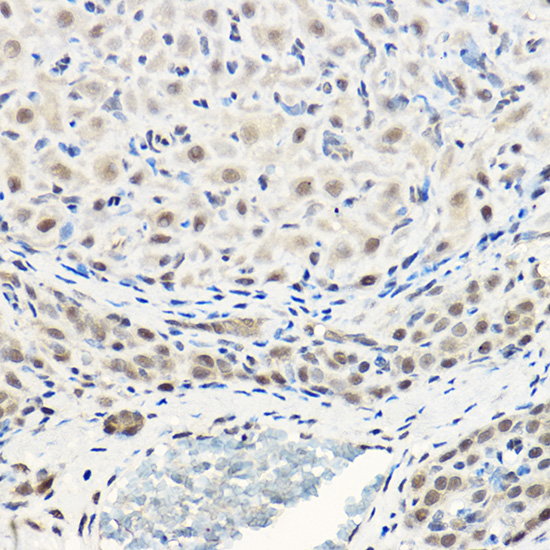
Immunohistochemistry analysis of paraffin-embedded Rat ovary using Pan-Akt Rabbit pAb (A18120) at dilution of 1:100 (40x lens). High pressure antigen retrieval performed with 0.01M Citrate buffer (pH 6.0) prior to IHC staining. |
|
|
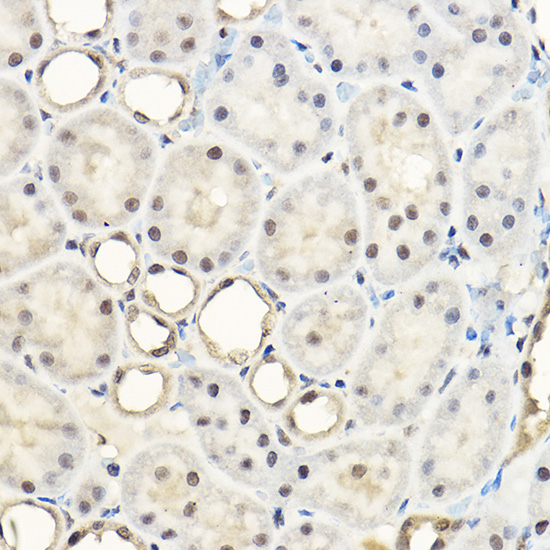
Immunohistochemistry analysis of paraffin-embedded Rat kidney using Pan-Akt Rabbit pAb (A18120) at dilution of 1:100 (40x lens). High pressure antigen retrieval performed with 0.01M Citrate buffer (pH 6.0) prior to IHC staining. |
|
|
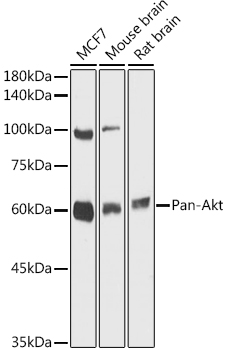
Western blot analysis of various lysates using Pan-Akt Rabbit pAb (A18120) at 1:1000 dilution. Secondary antibody: HRP-conjugated Goat anti-Rabbit IgG (H+L) (AS014) at 1:10000 dilution. Lysates/proteins: 25µg per lane. Blocking buffer: 3% nonfat dry milk in TBST. Detection: ECL Basic Kit (RM00020). Exposure time: 30s. |
|
|
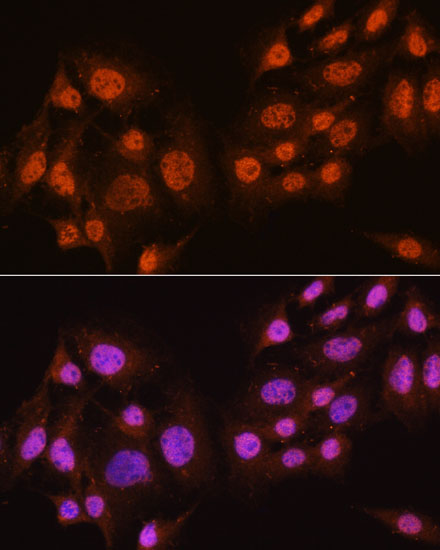
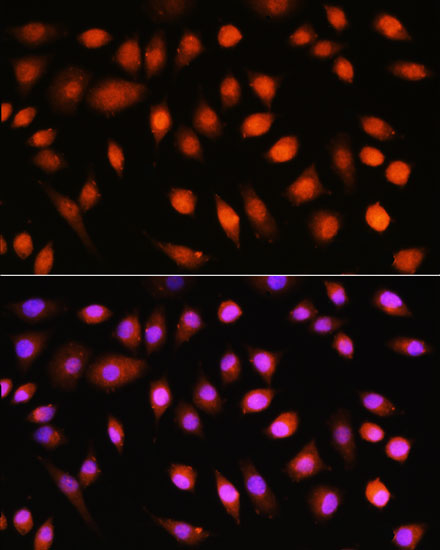
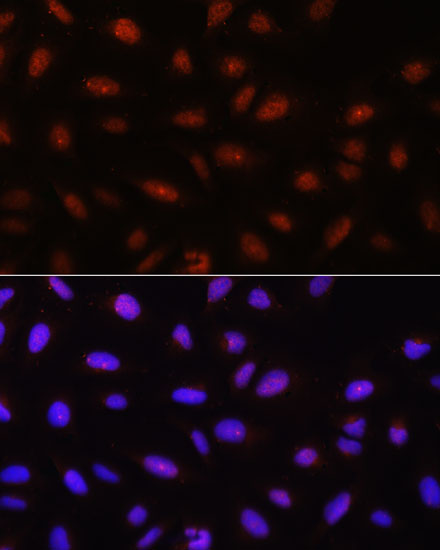
Immunofluorescence analysis of C6 cells using Pan-Akt Rabbit pAb (A18120) at dilution of 1:100. Secondary antibody: Cy3-conjugated Goat anti-Rabbit IgG (H+L) (AS007) at 1:500 dilution. Blue: DAPI for nuclear staining. |
|
|
Immunofluorescence analysis of L929 cells using Pan-Akt Rabbit pAb (A18120) at dilution of 1:100. Secondary antibody: Cy3-conjugated Goat anti-Rabbit IgG (H+L) (AS007) at 1:500 dilution. Blue: DAPI for nuclear staining. |
|
|
Immunofluorescence analysis of U-2 OS cells using Pan-Akt Rabbit pAb (A18120) at dilution of 1:100. Secondary antibody: Cy3-conjugated Goat anti-Rabbit IgG (H+L) (AS007) at 1:500 dilution. Blue: DAPI for nuclear staining. |
|
|
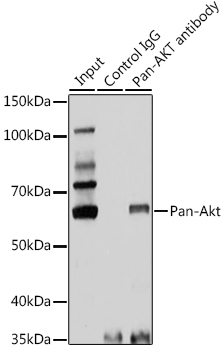
Immunoprecipitation analysis of 25 µg extracts of Rat brain tissue using 3 µg Pan-Akt antibody (A18120). Western blot was performed from the immunoprecipitate using Pan-Akt antibody (A18120) at a dilution of 1:1000. |
Product Guarantee and Expert Support
