Description
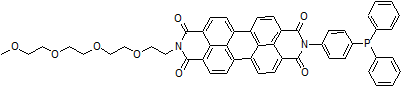
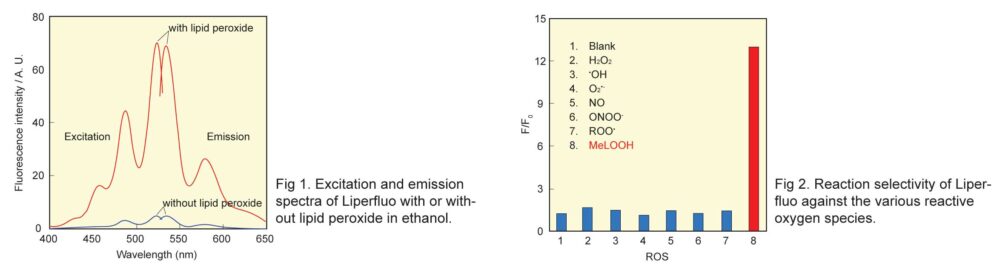
Liperfluo, a perylene derivative containing oligooxyethylene, is designed and exclusively developed by Dojindo for the detection of lipid peroxides. Liperfluo emits intense fluorescence by lipid peroxide specific oxidation in organic solvents such as ethanol. Among fluorescent probes that detect Reactive Oxygen Species(ROS), Liperfluo is the only compound that can specifically detect lipid peroxides. Since the excitation and emission wavelengths of the oxidized Liperfluo are 524 nm and 535 nm, respectively, photo-damage and auto-fluorescence from the sample can be minimized. The tetraethyleneglycol group linked to one end of diisoquinoline ring helps its solubility and dispersibility to aqueous buffer. Liperfluo’s oxidized form is nearly nonfluorescent in an aqueous media and emits a strong fluorescence in lipophilic sites such as in cell membranes. Therefore it can easily be applied to lipid peroxide imaging by a fluorescence microscopy and a flow cytometric analysis for living cells. Liperfluo is used to monitor lipid peroxidation in ferroptosis research.
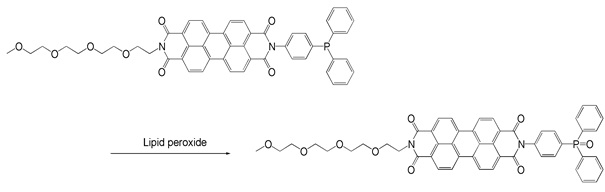
Reaction of Liperfluo with lipid peroxide
Technical info
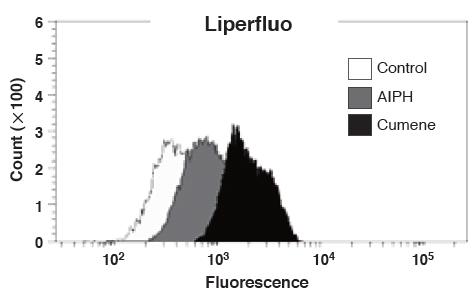
Flow cytometric analysis of lipid hydroperoxides in live cell
Procedure
1. Innoculate SH-SY5Y cells (6.0 x 10⁵ cells/well) to a 6-well plate.
2. Incubate the plate at 37 ºC for overnight.
3. Add Liperfluo, DMSO solution (final conc. 20 μM) and incubate at 37 ºC for 15 min.
4. Add either Cumene Hydroperoxide (final conc. 100 μM) or AIPH*(final conc. 6 mM).
5. Incubate at 37 ºC for 2 hours.
6. Wash cells with PBS.
7. Collect cells with PBA and analyse by flow cytometer**.* AIPH: 2,2 Eazobis-[2-(2-imidazolin-2-yl)propane]dihydrochloride** BD FACSAriaTM I
Data was kindly provided from Dr. N. Noguchi, Doshisha University, System Life Science Laboratory.
Examples of use in ferotosis research
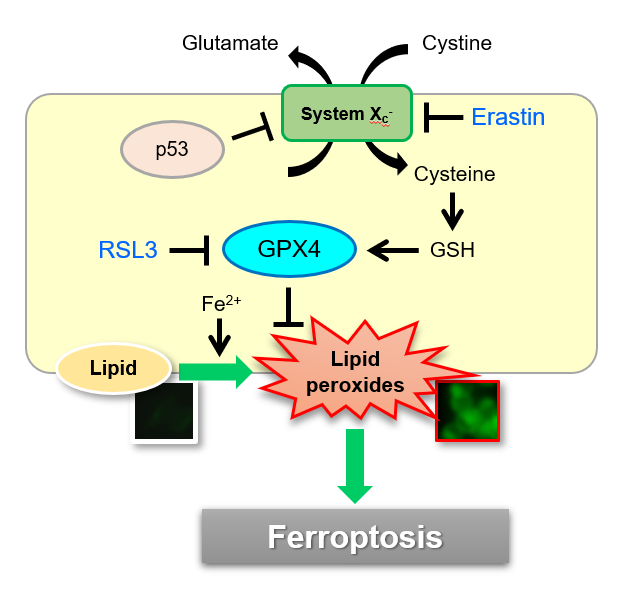
Necrosis, apoptosis and autophagy is known as cell death-related processes. In 2012, Ferroptosis was proposed as one of new cell deaths. Ferroptosis is studied as non apoptotic cell death caused by accumulation of iron ion-dependent lipid peroxide. Liperfluo is used as a fluorescent prove which can detect intracellular lipid peroxide directly.
Ferroptosis: A Regulated Cell Death Nexus Linking Metabolism, Redox Biology, and Disease.
B. R. Stockwell et al., Cell, 2017, 171(2), 273.
Oxidized Arachidonic/Adrenic Phosphatidylethanolamines Navigate Cells to Ferroptosis
V. E. Kagan et al., Nat. Chem. Biol., 2017, 13, (1), 81.
References
1) N. Soh, T. Ariyoshi, T. Fukaminato, H. Nakajima, K. Nakano and T. Imato, "Swallow-tailed Perylene Derivative: a new Tool for Fluorescent Imaging of Lipid Hydroperoxides", Org. Biomol. Chem., 2007, 5, 3762.
2) K. Yamanaka, Y. Saito, J. Sakiyama, Y. Ohuchi, F. Oseto and N. Noguchi, "A Novel Fluorescent Probe with High Sensitivity and Selective Detection of Lipid Hydroperoxides in Cells", RSC Adv., 2012, 2, (20), 7894.
3) V. E. Kagan, G. W. Mao, F. Qu, J. P. F. Angeli, S. Doll, C. S. Croix, H. H. Dar, B. Liu, V. A. Tyurin, V. B. Ritov, A. A. Kapralov, A. A. Amoscato, J. Jiang, T. Anthonymuthu, D. Mohammadyani, Q. Yang, B. Proneth, J. K. Seetharaman, S. Watkins, I. Bahar, J. Greenberger, R. K. Mallampalli, B. R. Stockwell, Y. Y. Tyurina, M. Conrad and H. Bayır, "Oxidized arachidonic and adrenic PEs navigate cells to ferroptosis", Nature Chemical Biology., 2017, 13, (1), 81.
4)Y. Nakashima, S. Ohta, A. M. Wolf, "Blue light-induced oxidative stress in live skin.", Free Radical Biology and Medicine., 2017, 108, 300.
5) M. Tsugita, N. Morimoto and M. Nakayama, "SiO2 and TiO2 nanoparticles synergistically trigger macrophage inflammatory responses", Particle and Fibre Toxicology., 2017, DOI 10.1186/s12989-017-0192-6.
6) K. Iuchi, A. Imoto, N. Kamimura, K. Nishimaki, H. Ichimiya, T. Yokota and S. Ohta, "Molecular hydrogen regulates gene expression by modifying the free radical chain reactiondependent generation of oxidized phospholipid mediators", Scientific Reports., 2016, DOI: 10.1038/srep18971.
7) A. J. Clark, and H. R. Petty., "WO3/Pt nanoparticles promote light-induced lipid peroxidation and lysosomal instability within tumor cells.", Nanotechnology., 2016, 27, (7), 075103.
8) T. Otani, M. Matsuda, A. Mizokami, N. Kitagawa, H. Takeuchi, E. Jimi, T. Inai and M. Hirata, "Osteocalcin triggers Fas/FasL-mediated necroptosis in adipocytes via activation of p300", Cell Death Dis., 2018, 9, 1194.
9) H.H. Dar, Y.Y. Tyurina, K. Mikulska-Ruminska, I. Shrivastava, H.C. Ting, V.A. Tyurin, J. Krieger, C.M. St Croix, S. Watkins, E. Bayir, G. Mao, C. Ambruster, A. Kapralov, H. Wang, M.H. Parsek, T.S. Anthonymuthu, A.F. Ogunsola, B.A. Flitter, C.J. Freedman, J.R. Gaston, T.R. Holman, J.M. Pilewski, J.S. Greenberger, R.K. Mallampalli, Y. Doi, J.S. Lee, I. Bahar, J.M. Bomberger, H. Bayır, V.E. Kagan, "Pseudomonas aeruginosa utilizes host polyunsaturated phosphatidylethanolamines to trigger theft-ferroptosis in bronchial epithelium.", J. Clin. Invest.., 2018,DOI: 10.1172/JCI99490. .
10) H. Alborzinia, T. I. Ignashkova, F. R. Dejure, M. Gendarme, J. Theobald, S. Wolfl, R. K. Lindemann and J. H. Reiling , "Golgi stress mediates redox imbalance and ferroptosis in human cells", Commun Biol.., 2018, 1, (210), DOI: 10.1038/s42003-018-0212-6.
11) W. Wang, M. Green, J. E. Choi, M. Gijon, P. D. Kennedy, J. K. Johnson, P. Liao, X. Lang, I. Kryczek, A. Sell, H. Xia, J. Zhou, G. Li, J. Li, W. Li, S. Wei, L. Vatan, H. Zhang, W. Szeliga , W. Gu, R. Liu, T. S. Lawrence, C. Lamb, Y. Tanno, M. Cieslik, E. Stone, G. Georgiou, T. A. Chan, A. Chinnaiyan, W. Zou, "CD8+ T cells regulate tumour ferroptosis during cancer immunotherapy.", Nature., 2019, 569(7755), 270-274.
12) M. Gao, J. Deng, F. Liu, A. Fan, Y. Wang, H. Wu, D. Ding, D. Kong, Z. Wang, D. Peer, Y. Zhao, 'Triggered ferroptotic polymer micelles for reversing multidrug resistance to chemotherapy', Biomaterials., 2019, 233, 119486.
13) N. Wang, GZ. Zeng, JL. Yin, ZX. Bian, Artesunate activates the ATF4-CHOP-CHAC1 pathway and affects ferroptosis in Burkitt's Lymphoma', Biochem. Biophys. Res. Commun., 2019, 519, (3), 533-539.
14) T.Tsukui, Takayuki Tsukui, Z. Chen, H. Fuda, T. Furukawa, K. Oura, T. Sakurai, S. Hui, H. Chiba, 'Novel Fluorescence-Based Method To Characterize the Antioxidative Effects of Food Metabolites on Lipid Droplets in Cultured Hepatocytes', J. Agric. Food Chem., 2019, 67, (35), 9934-9941.
15) P. K. Mishra, A. Adameova, J. A. Hill, C. P. Baines, P. M. Kang, J. M. Downey, J. Narula, M. Takahashi, A. Abbate, H. C. Piristine, S. Kar, S. Su, J. K. Higa, N. K. Kawasaki and T. Matsui, Guidelines for evaluating myocardial cell death', Am. J. Physiol.: Heart Circ. Physiol. ., 2019, 317, (5), H891-H922 .
16) C. Liang, X. Zhang, M. Yang and X. Dong, Recent Progress in Ferroptosis Inducers for Cancer Therapy", Adv. Mater.., 2019,doi.org/10.1002/adma.201904197.
17) B. R. Stockwell and X. Jiang, The Chemistry and Biology of Ferroptosis", Cell Chem. Biol.., 2020, 27. |