

DDDDK-Tag Rabbit mAb, Unconjugated
Artikelnummer:
ABB-AE092
- Bilder (9)
| Artikelname: | DDDDK-Tag Rabbit mAb, Unconjugated |
| Artikelnummer: | ABB-AE092 |
| Hersteller Artikelnummer: | AE092 |
| Alternativnummer: | ABB-AE092-50UL,ABB-AE092-500UL,ABB-AE092-1000UL,ABB-AE092-200UL,ABB-AE092-100UL |
| Hersteller: | ABclonal |
| Wirt: | Rabbit |
| Kategorie: | Antikörper |
| Applikation: | ChIP, ELISA, FC, IF, IP, WB |
| Spezies Reaktivität: | Human |
| Immunogen: | Synthetic peptide. This information is considered to be commercially sensitive. |
| Konjugation: | Unconjugated |
| Alternative Synonym: | DDDDK, DDDDK tag, DDDDK-tag, DDDDK-Tag |
| FLAG-tag, or FLAG octapeptide, or FLAG epitope, is a polypeptide protein tag that can be added to a protein using recombinant DNA technology, having the sequence motif DYKDDDDK. It has been used for studying proteins in living cells and for protein purification by affinity chromatography. It has been used to separate recombinant, overexpressed protein from wild-type protein expressed by the host organism. It can also be used in the isolation of protein complexes with multiple subunits, because its mild purification procedure tends not to disrupt such complexes. It has been used to obtain proteins of sufficient purity and quality to carry out 3D structure determination by x-ray crystallography.A FLAG-tag can be used in many different assays that require recognition by an antibody. If there is no antibody against a given protein, adding a FLAG-tag to a protein allows the protein to be studied with an antibody against the FLAG sequence. Examples are cellular localization studies by immunofluorescence or detection by SDS PAGE protein electrophoresis and Western blotting. |
| Klonalität: | Monoclonal |
| Klon-Bezeichnung: | [ARC5111-01] |
| Reinheit: | Affinity purification |
| Sequenz: | DYKDDDDK |
| Target-Kategorie: | DDDDK |
| Antibody Type: | Primary Antibody |
| Application Verdünnung: | WB,1:5000 - 1:20000|IP,0.5µg-4µg antibody for 200µg-400µg extracts of whole cells|IF/ICC,1:300 - 1:2000|FC,1:50 - 1:200|ChIP,5 µg antibody for 10 µg-15 µg of Chromatin|ChIP-seq,1:50 - 1:200|ELISA,Recommended starting concentration is 1 µg/mL. Please optim |
| Anwendungsbeschreibung: | Cross-Reactivity: Species independent. Shipping: Ice Bag |
|
|
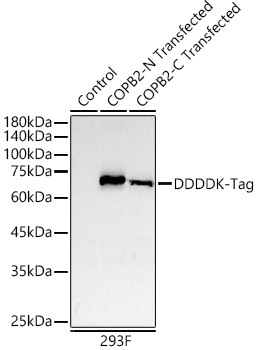
Western blot analysis of lysates from wild type (WT),293F transfected with COPB2-N Protein,COPB2-C Protein,using DDDDK-Tag antibody (AE092) at 1:10000 dilution. Secondary antibody: HRP Goat Anti-Rabbit IgG (H+L) (AS014) at 1:10000 dilution. Lysates/proteins: 25µg per lane. Blocking buffer: 3% nonfat dry milk in TBST. Detection: ECL Basic Kit (RM00020). Exposure time: 30s. |
|
|
Chromatin immunoprecipitation was performed with 21.8 µg of cross-linked chromatin from 293T cells transfected with a GATA3 expression vector containing a single C-terminal DDDDK-Tag using 5 µg of Rabbit anti DDDDK-Tag (AE092). DNA libraries were prepared using Scale ssDNA-seq Lib Prep Kit for Illumina V2 (RK20228). The ChIP sequencing results indicate the enrichment pattern of DDDDK-Tag across chromosome 2 (upper panel) and the genomic region encompassing SH3RF3, a representative gene enriched in DDDDK-Tag (lower panel). |
|
|
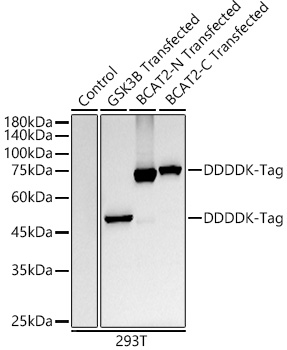
Western blot analysis of lysates from wild type (WT) and 293T cells transfected with GSK3B Protein,BCAT2-N Protein,BCAT2-C Protein, using DDDDK-Tag antibody (AE092) at 1:10000 dilution. Secondary antibody: HRP Goat Anti-Rabbit IgG (H+L) (AS014) at 1:10000 dilution. Lysates/proteins: 25µg per lane. Blocking buffer: 3% nonfat dry milk in TBST. Detection: ECL Basic Kit (RM00020). Exposure time: 10s. |
|
|
Chromatin immunoprecipitation was performed with 21.8 µg of cross-linked chromatin from 293T cells transfected with a GATA3 expression vector containing a single C-terminal DDDDK-Tag using 5 µg of Rabbit anti DDDDK-Tag (AE092). DNA libraries were prepared using Scale ssDNA-seq Lib Prep Kit for Illumina V2 (RK20228). The ChIP sequencing results indicate the enrichment pattern of DDDDK-Tag in the representative genomic region surrounding SH3RF3 gene. |
|
|
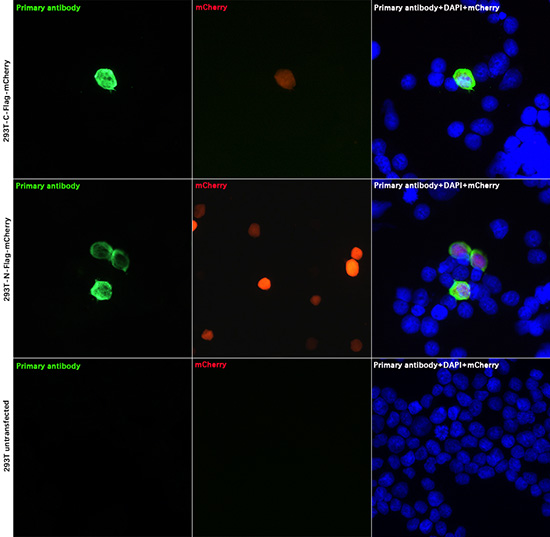
Confocal imaging of 293T cells transfected with GFP-DDDDK-Tag (N) and 293T cells transfected with GFP-DDDDK-Tag (C) cells using DDDDK-Tag Rabbit mAb (AE092, dilution 1:300) followed by a further incubation with Cy3-conjugated Goat anti-Rabbit IgG (H+L) (AS007, dilution 1:500) (Red). DAPI was used for nuclear staining (Blue). Objective: 100x. |
|
|
Confocal imaging of 293F cells transfected with GFP-DDDDK-Tag (N) and 293F cells transfected with GFP-DDDDK-Tag (C) cells using DDDDK-Tag Rabbit mAb (AE092, dilution 1:1600) followed by a further incubation with Cy3 Goat Anti-Rabbit IgG (H+L) (AS007, dilution 1:500) (Red). DAPI was used for nuclear staining (Blue). Objective: 100x. |
|
|
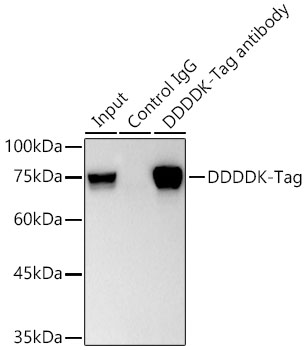
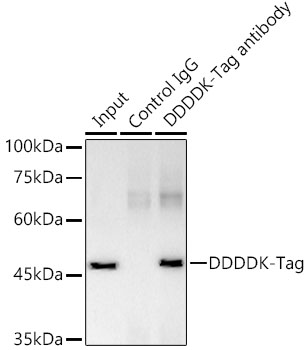
Immunoprecipitation of DDDDK-Tag from 300 ug extracts of 293T cells transfected with a SERPINB1 expression vector containing a single N-terminal DDDDK-Tag was performed using 3 µg of DDDDK-Tag Rabbit mAb(AE092). Rabbit IgG isotype control (AC042) was used to precipitate the Control IgG sample. The IP sample was eluted with 1X reducing Laemmli Buffer. The Input lane represents 10% of the total input. Western blot analysis of immunoprecipitates was conducted using DDDDK-Tag Rabbit mAb (AE092) at a dilution of 1:2000. |
|
|
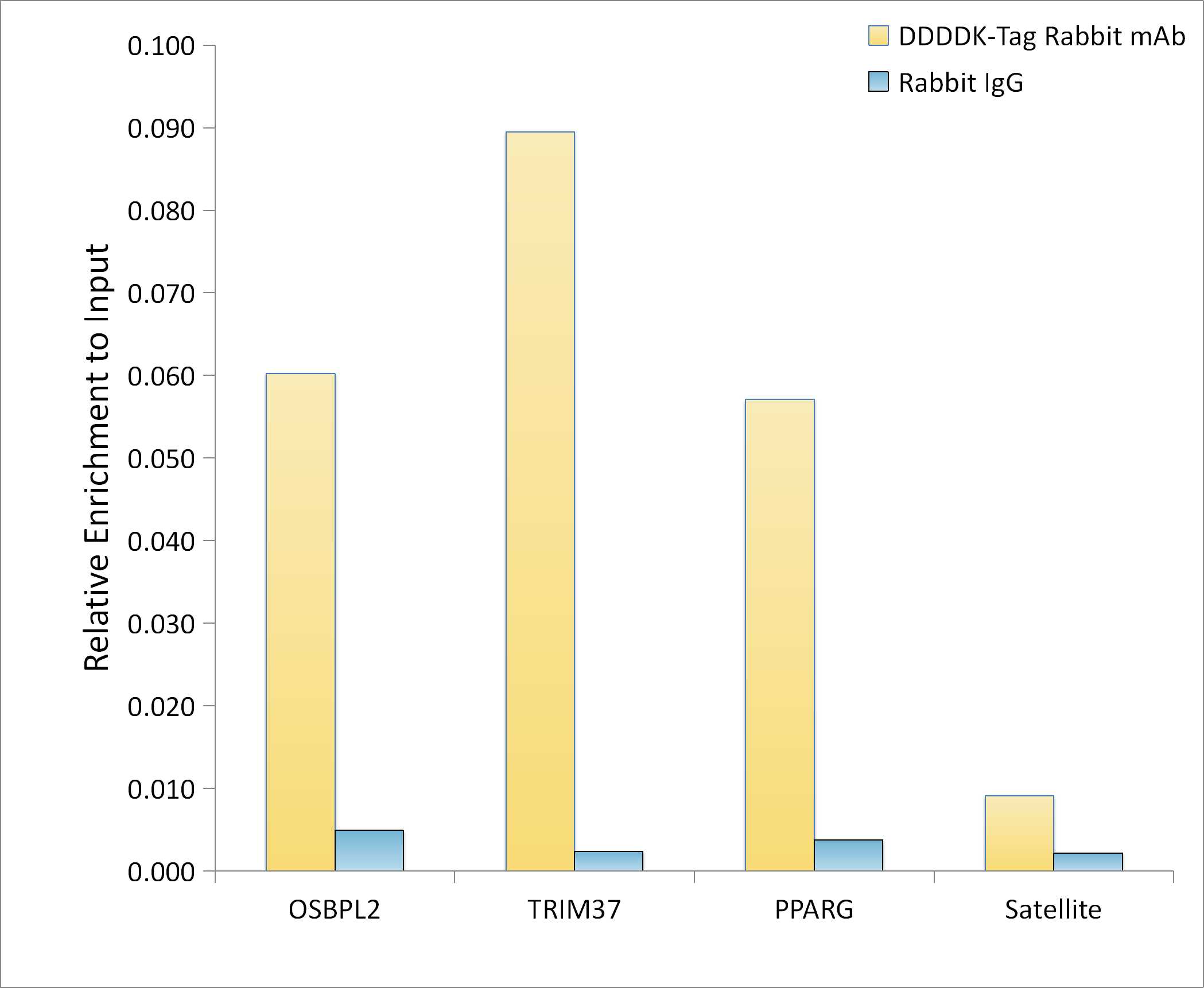
Chromatin immunoprecipitation was performed with 20 µg of cross-linked chromatin from 293F cells (left) and 293F cells transfected with BATF3 (right), using 2 µg of DDDDK-Tag Rabbit mAb (AE092) and Rabbit IgG isotype control (AC042). The enrichment of immunoprecipitated DNA at different genomic loci was examined by quantitative PCR. The histogram compares the ratio of the immunoprecipitated DNA to the input at given loci. |
|
|
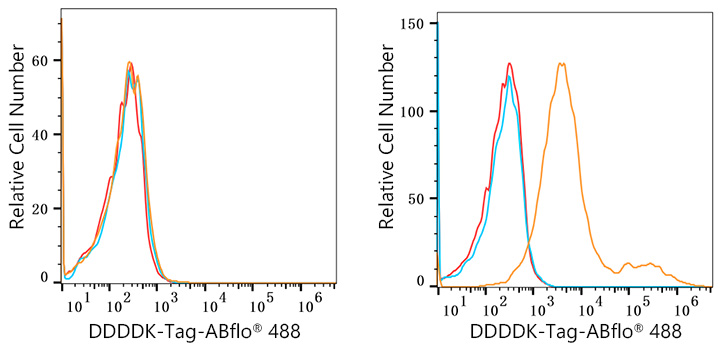
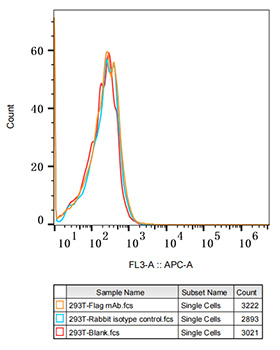
Flow cytometry: 1X10 6 293T cells (negative control,left) and 293T (Transfection,right) cells were surface-stained with DDDDK-Tag Rabbit mAb (AE092, 2.5 µg/mL orange line) or Rabbit IgG isotype control (AC042,2 µg/mL,blue line), followed by Alexa Fluor 488 conjugated goat anti-rabbit pAb staining. Non-fluorescently stained cells were used as blank control (red line). |
Produktgarantie und fachkundiger Support
